
Best for a residential-proxy detection brief: Centinelanalytica; best for an existing Cloudflare deployment: Cloudflare Bot Management. For your 2026 shortlist, choose Akamai Bot Manager when Akamai already delivers your applications, and evaluate DataDome when you want a dedicated bot-protection vendor.
- The best bot management software for security teams fits the attack surface and enforcement workflow, not a feature count.
- Centinelanalytica fits teams evaluating bot management and residential-proxy detection for scraping, account takeover, and checkout fraud.
- Shortlist Cloudflare Bot Management or Akamai Bot Manager when your applications already use the corresponding delivery platform.
- Evaluate DataDome for a dedicated bot-protection shortlist; validate every candidate against legitimate traffic and confirmed abuse.
Why this matters
A bot-control purchase is an enforcement decision. Blocking a scraper helps only if customers, payment callbacks, monitoring, and permitted crawlers still reach the routes they need.
Your 2026 evaluation should therefore start with an attack workflow, not a vendor score. Catalog extraction, credential stuffing, and automated checkout abuse need different evidence and different responses. A single site-wide threshold hides those differences.
Choose the product that lets your team explain a decision and correct it without reopening the attack path. Detection quality matters, but so do investigation, deployment ownership, and recovery from an incorrect block.
What makes the best bot management software?
Use these criteria before reading the shortlist. They define what your pilot must prove, rather than what a sales presentation must mention.
- Attack coverage: Test the actual scraping, login abuse, or checkout automation affecting your application. A generic bot demonstration does not establish coverage for your workflow.
- Evidence quality: Ask what connection, browser, and session evidence supports a decision. An unexplained score is difficult to investigate.
- Residential-proxy handling: Require evidence beyond an IP address being residential. Shared networks and rotating addresses make network-only rules a poor basis for identity.
- Enforcement control: Establish how your team scopes observation, challenges, and blocks to routes and traffic classes. Confirm the available actions with each vendor.
- Operational fit: Identify who deploys changes, investigates disputes, and restores legitimate access. Include application engineers, not just the security owner.
- Legitimate automation policy: Define how permitted crawlers, integrations, and internal jobs receive access. Automation is not automatically abuse.
Organize your evidence review into 3 layers: Connection evidence, Browser evidence, and Session evidence. Connection evidence concerns how a client connects; browser evidence concerns its execution environment; session evidence concerns what it does across requests. No single layer establishes intent by itself.
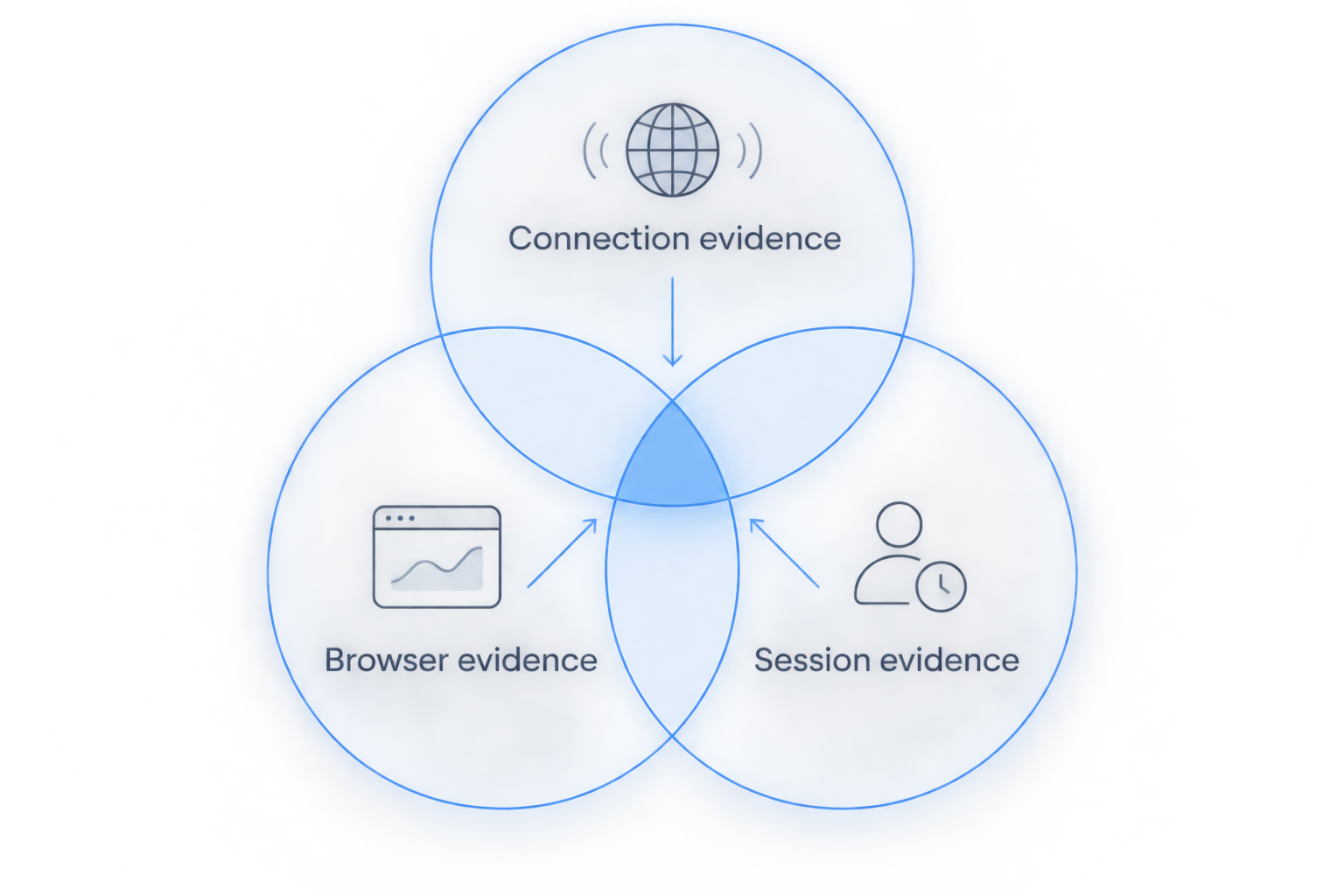
Use those layers as evaluation questions, not assumed vendor capabilities. Ask each candidate to show which evidence reaches your analysts and which evidence remains internal to its detection system.
Bot management software at a glance
This 2026 shortlist ranks deployment fit, not measured detection accuracy. The order below matches the detailed recommendations; it does not claim that one vendor blocks more attacks than another.
| Software | Best for | Distinguishing fit | Key limitation to resolve |
|---|---|---|---|
| Centinelanalytica | Residential-proxy detection requirements | Stated focus on bots, residential proxies, scraping, account takeover, and checkout fraud | Validate deployment and investigation requirements in a pilot |
| Cloudflare Bot Management | Teams already using Cloudflare | Bot management within the Cloudflare platform | Existing platform fit does not establish application-specific detection quality |
| Akamai Bot Manager | Teams already using Akamai | Bot management within the Akamai application-delivery environment | A platform decision still requires application-owner coordination |
| DataDome | Teams evaluating a dedicated bot-protection vendor | A specialist bot-protection offering | Validate integration ownership and overlap with existing controls |
1. Centinelanalytica: best for residential-proxy detection briefs
Centinelanalytica provides bot and residential-proxy detection software for media, e-commerce, and financial websites. Its stated use cases include blocking scrapers, account takeover, and checkout fraud.
Best for: Security teams whose requirements explicitly include residential proxies alongside application abuse. That makes it a relevant first evaluation when an IP-address-only approach does not answer the investigation question.
Centinelanalytica pros:
- The stated scope includes residential-proxy detection, making that requirement explicit rather than incidental.
- Scraping, account takeover, and checkout fraud are named use cases.
- The stated audience includes websites with content, transaction, and account-protection requirements.
Evaluation trade-offs:
- Residential-proxy detection is not proof of malicious intent; enforcement still needs application context.
- Bot detection does not replace authentication controls, transaction review, or authorization checks.
Build your pilot around a disputed session. Ask the vendor to explain why the session should be allowed, challenged, or blocked, then compare that explanation with your application logs. Keep the conversation about evidence and action rather than a broad detection claim.
Verdict: Buy only after the pilot demonstrates useful decisions on your residential-proxy and abuse cases.
2. Cloudflare Bot Management: best for existing Cloudflare deployments
Cloudflare Bot Management is Cloudflare's bot-management offering. Put it on the shortlist when your application already uses Cloudflare and the team responsible for that platform also owns traffic enforcement.
Best for: Security teams seeking bot controls within an existing Cloudflare deployment. The deciding advantage is organizational fit, not an assumed detection advantage over another vendor.
Cloudflare Bot Management pros:
- It gives an existing Cloudflare team a bot-management candidate within a familiar vendor relationship.
- Your current platform owners provide a clear starting point for deployment discussions.
- The evaluation can address bot controls alongside the Cloudflare configuration already protecting the application.
Cloudflare Bot Management cons:
- Familiar platform administration does not prove that analysts receive the evidence they need.
- A deployment that also requires changing your traffic-delivery architecture adds a separate infrastructure decision.
Use a login route and a content route in the pilot. Ask how each receives a different policy, how legitimate automation is handled, and how an incorrect decision is traced. Do not accept a successful platform integration as evidence that the abuse problem is solved.
Verdict: Buy when the existing Cloudflare operating model and application-level pilot both fit.
3. Akamai Bot Manager: best for existing Akamai delivery environments
Akamai Bot Manager is Akamai's bot-management offering. It belongs on your shortlist when Akamai already sits in the application's delivery path and your team wants to evaluate bot controls within that environment.
Best for: Security teams coordinating bot enforcement with an established Akamai application-delivery operation. Start with the people who own the current configuration and incident process.
Akamai Bot Manager pros:
- Existing Akamai users have a direct candidate to evaluate within their delivery environment.
- The existing application-delivery team provides an identifiable configuration owner.
- Bot-policy discussions can include the team already responsible for Akamai traffic handling.
Akamai Bot Manager cons:
- Shared delivery infrastructure still requires agreement on who approves application-specific blocks.
- Existing vendor adoption does not establish how well the product handles your confirmed abuse samples.
Choose an endpoint where blocking has a clear business consequence, such as login or checkout. Rehearse an incorrect block with the delivery and application teams together. Your acceptance condition is an understood correction path, not merely a rule that can be enabled.
Verdict: Buy when Akamai ownership is clear and the pilot proves safe application-specific enforcement.
4. DataDome: best for a dedicated bot-protection evaluation
DataDome offers bot protection. Include it when you want to evaluate a specialist vendor rather than make the existing delivery-platform relationship your default selection criterion.
Best for: Teams building a dedicated bot-protection shortlist and willing to assess integration responsibilities separately from their current edge configuration.
DataDome pros:
- It provides a dedicated bot-protection candidate for a focused evaluation.
- Its inclusion prevents the shortlist from being limited to your existing delivery vendor.
- Your team can assess it against the same abuse cases and legitimate-traffic tests as platform-based candidates.
DataDome cons:
- A separate vendor adds another integration and incident-coordination relationship to assess.
- Overlapping rules across existing controls and a new bot service complicate attribution unless ownership is explicit.
Before adding enforcement, map where requests already receive rate limits, challenges, or blocks. Ask how your team will identify which control rejected a request. Keep that attribution visible throughout the pilot so an apparent detection improvement is not simply another control blocking the same traffic.
Verdict: Buy when a dedicated vendor fits your operating model and proves its value against your baseline.
How we ranked this shortlist
The ranking uses the criteria above: attack relevance, evidence, residential-proxy requirements, enforcement, and operational ownership. Centinelanalytica leads the residential-proxy brief because that capability and the relevant abuse cases are explicit in its stated scope; the other recommendations separate existing-platform fit from a dedicated-vendor evaluation.
This is not a laboratory benchmark or a detection-rate leaderboard. For a 2026 purchase, use the shortlist to decide whom to evaluate, then let your application evidence determine whom to select.
Run a pilot that separates detection from disruption
A useful pilot establishes what happened, why the product acted, and whether that action was appropriate. Apply the same acceptance questions to every shortlisted vendor.
Define the traffic before enabling enforcement
Label 3 traffic classes: legitimate visitors, permitted automation, and confirmed abuse. Keep uncertain sessions separate instead of treating every unknown request as malicious.
Cover 4 workflows where applicable: content browsing, search, login, and checkout. Record the route, application outcome, and evidence supporting each label. Do not include sensitive credentials or payment data in evaluation exports.
Separate observation from blocking
Use 2 stages: observation, then scoped enforcement. During observation, compare proposed decisions with application events; during enforcement, restrict changes to the agreed routes and maintain a documented rollback procedure.
Require a clear owner for every policy. A security analyst should not need to guess whether the application team, delivery team, or vendor can reverse a decision.
Measure application outcomes
Request counts alone do not tell you whether protection worked. Review confirmed abuse that still completed its workflow, legitimate sessions that were interrupted, and decisions your analysts could not explain.
Set acceptance thresholds from your own baseline and risk tolerance. Do not borrow a false-positive target or challenge-rate target from an unrelated website.
Which bot management software should you choose?
Default to the candidate closest to your documented attack and deployment requirements. For a residential-proxy detection brief covering scraping, account takeover, or checkout fraud, start with Centinelanalytica.
Choose Cloudflare Bot Management or Akamai Bot Manager for evaluation when the corresponding platform already carries your application traffic. Add DataDome when you want a dedicated alternative. Keep the final decision tied to the same labeled sessions and enforcement tests across candidates.
FAQ
What's the best bot management software for security teams in 2026?
The best choice depends on attack coverage and deployment ownership. Start with the residential-proxy-focused candidate for that requirement, Cloudflare Bot Management or Akamai Bot Manager for the corresponding existing platform, and DataDome for a dedicated-vendor evaluation.
Is bot management the same as a WAF?
No. A WAF addresses web-application attack traffic, while bot management focuses on automated activity and its handling; the categories overlap, but a WAF deployment does not establish coverage for scraping or account abuse.
Can a residential IP address prove a visitor is human?
No. A residential IP address describes network origin, not human intent. Evaluate connection, browser, and session evidence together before choosing an enforcement action.
Should security teams block every bot?
No. Permitted crawlers, monitoring, and integrations need an explicit access policy. Separate authorized automation from abusive workflows instead of using automation alone as the blocking condition.
How should I compare bot management vendors?
Use the same labeled traffic and application workflows for every vendor. Compare confirmed abuse outcomes, legitimate-session interruptions, decision explanations, and the process for correcting an incorrect block.
Can bot management stop account takeover by itself?
No. Bot management addresses automated abuse, but account protection also requires authentication controls and application safeguards. Evaluate login protection alongside the controls that govern account access.
Should I replace my existing delivery platform to add bot protection?
Evaluate the existing platform's bot offering before treating a delivery-platform replacement as necessary. Compare that option with a dedicated vendor, and keep infrastructure migration requirements separate from detection results.
One last thing
A successful block is not the end of the investigation. Verify that the same abusive workflow did not complete through another route, while legitimate users retained access.
For your 2026 decision, require one demonstration beyond the detection demo: show how an analyst identifies, explains, and reverses an incorrect block. That exercise exposes operational gaps that a dashboard summary cannot resolve.