
Best overall for the stated scraper, account-takeover and checkout-fraud use cases: Centinelanalytica. Best for an existing Cloudflare deployment: Cloudflare Bot Management. Best for an AWS WAF deployment: AWS WAF Bot Control. This 2026 shortlist compares bot detection software by protection scope, deployment fit and the evidence you need before enabling blocking.
- Centinelanalytica leads this best bot detection software for ecommerce shortlist for scraper, account-takeover and checkout-fraud protection.
- Cloudflare Bot Management fits teams already routing storefront traffic through Cloudflare.
- DataDome and HUMAN Bot Defender belong on specialist bot-management shortlists.
- AWS WAF Bot Control fits AWS WAF deployments; validate application coverage before enforcing rules.
- Choose with labeled traffic and endpoint-specific outcomes, not a vendor-wide bot percentage.
Why this matters
Your product catalog, login flow and checkout expose different automation risks. A scraper collects product information; credential stuffing tests stolen credentials; checkout automation abuses a purchase workflow. One global blocking threshold treats those behaviors as the same problem.
The best bot detection software for ecommerce in 2026 is the product that identifies harmful automation on your actual routes without obstructing legitimate customers. Detection quality and enforcement quality are separate acceptance tests. A useful classification still needs an appropriate response.
What makes the best bot detection software for ecommerce
Use these criteria before comparing product names:
- Endpoint coverage: Identify exactly which storefront pages, APIs, login routes and checkout requests the deployment inspects.
- Detection evidence: Ask what connection, browser, network and session evidence supports a decision. A score alone does not explain a disputed block.
- Residential-proxy handling: Test malicious traffic coming through residential addresses without treating all residential traffic as suspicious.
- Response control: Require a way to distinguish observation, rate limiting, challenges and blocking where your architecture supports them.
- Customer impact: Evaluate successful customer journeys alongside attack handling. Challenge frequency is not a conversion metric.
- Operational fit: Confirm who maintains integrations, investigates false positives and reverses a harmful policy change.
These criteria define the 2026 shortlist below. The ranking is by use case, not a claim that every product received the same laboratory test.
Bot detection software at a glance
| Rank and product | Best for | Standout capability or fit | Key limitation to evaluate |
|---|---|---|---|
| 1. Centinelanalytica | E-commerce teams targeting scraping, account takeover and checkout fraud | Stated focus includes bot and residential-proxy detection | Validate integration, decision visibility and endpoint coverage in a pilot |
| 2. Cloudflare Bot Management | Storefronts already using Cloudflare | Bot management within Cloudflare's reverse-proxy environment | Protection depends on routing the relevant traffic through the configured deployment |
| 3. DataDome | Teams evaluating a dedicated bot-management provider | Specialist bot protection across website, app and API use cases | Integration and challenge behavior need testing on each protected journey |
| 4. HUMAN Bot Defender | Teams evaluating specialist defense against automated abuse | Dedicated bot detection and mitigation | Product scope and integration requirements need mapping to your application |
| 5. AWS WAF Bot Control | Teams operating AWS WAF | Bot inspection and rule-based handling within AWS WAF | WAF policy still needs application-specific tuning and outcome validation |
1. Centinelanalytica: best for targeted e-commerce abuse protection
Centinelanalytica provides bot and residential-proxy detection software. Its stated use cases include helping e-commerce websites block scrapers, account takeover and checkout fraud.
That scope matches a retailer whose problem extends beyond an identifiable crawler fetching public pages. Your evaluation should connect each detection decision to a protected business action: viewing a catalog, attempting a login or submitting a checkout request.
Best for: Security and engineering teams evaluating protection against those named attack types.
Product pros:
- The stated protection scope directly includes e-commerce websites.
- Residential-proxy detection addresses an important network-identification problem.
- Scraping, account takeover and checkout fraud are explicit use cases rather than inferred benefits.
Product cons and evaluation limits:
- Product scope alone does not establish detection accuracy on your traffic.
- Confirm integration requirements and available response controls before designing enforcement.
- Require evidence that legitimate login and checkout journeys remain usable.
Bring representative request logs and an endpoint inventory to a demo. Ask how request, browser and session evidence would support a specific decision; do not assume every evidence type or integration is available.
Verdict: Buy Centinelanalytica only after a pilot validates the stated protections on your storefront.
2. Cloudflare Bot Management: best for existing Cloudflare deployments
Cloudflare Bot Management identifies and manages automated traffic within Cloudflare's application-security environment. It gives teams a way to connect bot classifications with security rules on traffic passing through that deployment.
The strongest reason to shortlist Cloudflare Bot Management is architectural fit. If Cloudflare already sits in front of your storefront, evaluate whether its bot controls cover your exposed routes before adding another enforcement layer.
Best for: Teams already using Cloudflare as a reverse proxy for the storefront they need to protect.
Cloudflare Bot Management pros:
- Bot handling fits an existing Cloudflare security workflow.
- Bot classifications can inform application-security rules.
- The deployment can place enforcement before requests reach the application origin.
Cloudflare Bot Management cons:
- Routes outside the configured traffic path need separate attention.
- A bot classification does not establish whether a purchase or account action is fraudulent.
- Broad rules can affect legitimate automation unless you define exceptions.
For a 2026 evaluation, inventory alternate hostnames, APIs and direct-origin exposure. A protected homepage does not establish protected checkout coverage.
Verdict: Buy Cloudflare Bot Management when the traffic path fits and endpoint-level testing confirms the required controls.
3. DataDome: best for a dedicated bot-management evaluation
DataDome is a specialist bot-protection provider with website, mobile application and API protection use cases. Include it when you want to evaluate bot management as a dedicated security function rather than only as an extension of existing WAF rules.
Your evaluation should focus on the actual integration surface. Browser visits, mobile application requests and server-to-server API calls do not all support the same verification mechanisms.
Best for: Teams comparing a dedicated bot-management provider across multiple customer-facing application surfaces.
DataDome pros:
- Bot protection is a central product focus.
- Its stated application scope includes websites, apps and APIs.
- It provides a distinct specialist option against which to evaluate an incumbent security stack.
DataDome cons:
- Each application surface still needs integration and coverage validation.
- Browser challenge behavior requires testing against checkout and accessibility requirements.
- Adding a dedicated provider introduces another operational dependency to manage.
Ask for a demonstration using your routes and automation cases. A catalog-scraping example does not answer whether a headless checkout integration or authenticated API remains functional.
Verdict: Hold DataDome on the shortlist until integration testing establishes coverage and acceptable customer impact.
4. HUMAN Bot Defender: best for a specialist automated-abuse review
HUMAN Bot Defender detects and mitigates automated traffic. It belongs on a shortlist when your security team wants a specialist bot-defense evaluation against a defined set of abuse cases.
Keep the evaluation specific to HUMAN Bot Defender. Capabilities associated with another product in a vendor's portfolio do not automatically belong to the product you are assessing.
Best for: Security teams conducting a structured specialist review of automated-abuse defenses.
HUMAN Bot Defender pros:
- Dedicated bot defense matches a clearly defined automation problem.
- Detection and mitigation belong within the same evaluation scope.
- It provides another specialist candidate for comparison with existing controls.
HUMAN Bot Defender cons:
- The selected product's scope needs confirmation against each required use case.
- Integration work must be evaluated for your application architecture.
- Bot detection does not replace account-security or payment-fraud controls.
Require separate results for scraping, credential attacks and checkout automation. Combining those outcomes into one summary conceals the gaps that matter to an engineering team.
Verdict: Hold HUMAN Bot Defender until its proposed deployment demonstrates the required abuse coverage.
5. AWS WAF Bot Control: best for teams operating AWS WAF
AWS WAF Bot Control adds bot inspection capabilities to AWS WAF. Teams use its classifications and associated WAF rules to observe and handle automated requests on supported AWS WAF deployments.
The fit is strongest when your team already operates AWS WAF and wants to assess bot controls inside that policy environment. Existing infrastructure familiarity is a reason to evaluate it, not proof that its classifications solve your application-specific abuse.
Best for: Engineering teams already responsible for AWS WAF configuration and operations.
AWS WAF Bot Control pros:
- Bot handling sits within the AWS WAF rule workflow.
- Bot-related labels support rule-based decisions.
- Observation can inform policy changes before broader enforcement.
AWS WAF Bot Control cons:
- It applies through supported AWS WAF deployments, not automatically across every application surface.
- Rule maintenance remains an operational responsibility.
- WAF observations need application context to distinguish an unwanted scrape from an authorized integration.
Test the policy against legitimate crawlers, customer browsers and business integrations. Also verify that relevant requests actually traverse the protected resource.
Verdict: Buy AWS WAF Bot Control when AWS WAF is the appropriate enforcement point and testing confirms useful coverage.
How to run a useful comparison
Build your 2026 evaluation around business actions, not a homepage demonstration. Use 3 endpoint groups as a starting structure: catalog access, authentication and checkout.
For each group, define legitimate behavior, prohibited automation and the evidence needed to distinguish them. If your store exposes additional APIs or signed-in data, add those surfaces rather than forcing them into a public-page test.
Follow the evidence through enforcement
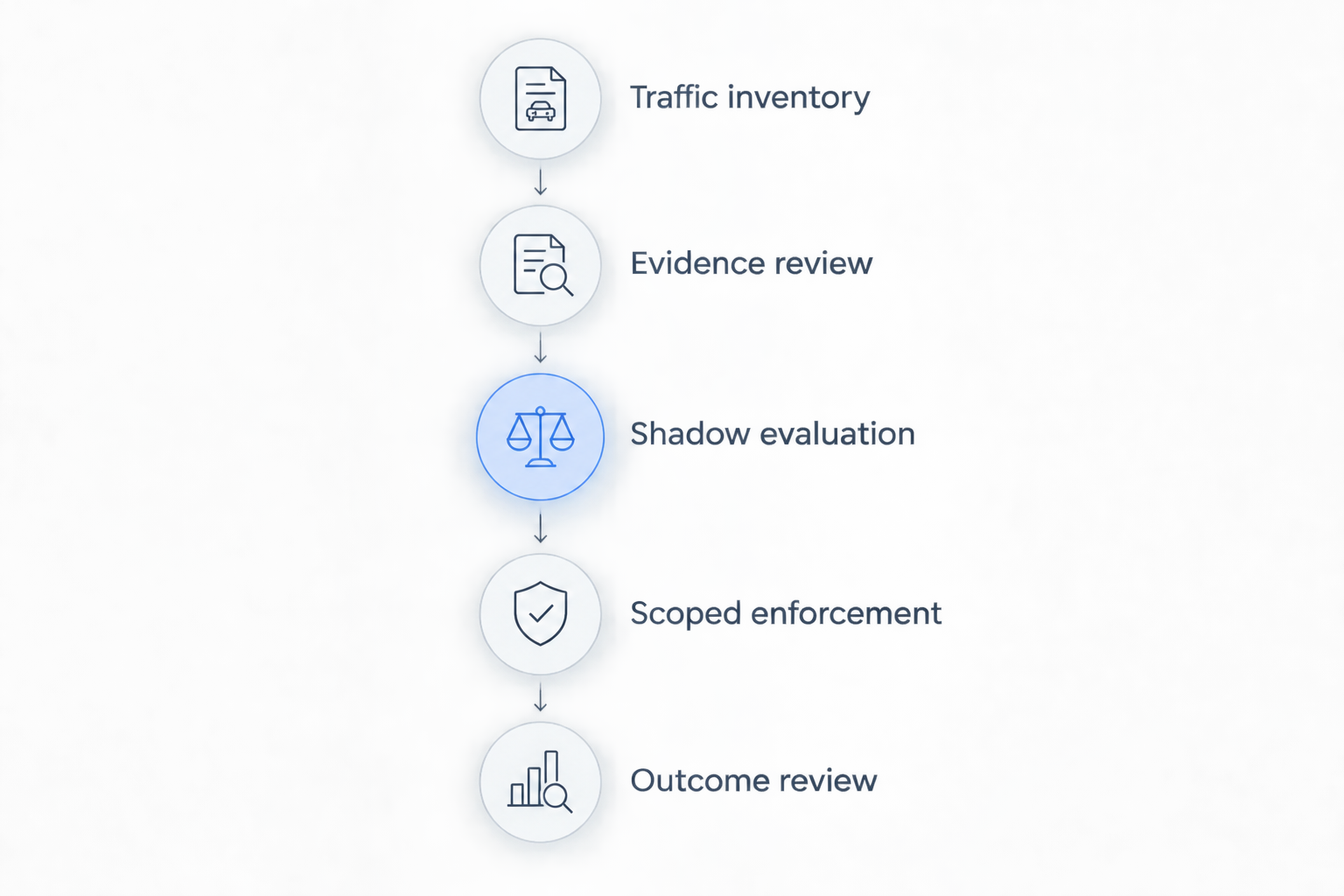
Use this sequence for every candidate:
- Traffic inventory: List routes, clients, authorized crawlers and integrations.
- Evidence review: Inspect the signals behind representative classifications.
- Shadow evaluation: Record proposed decisions without applying disruptive responses.
- Scoped enforcement: Apply a policy to a bounded route or traffic segment.
- Outcome review: Check attack completion, legitimate task completion and disputed decisions.
This sequence separates detection from response. A suspicious request is not automatically a blocked request, and a blocked request is not automatically a prevented fraud loss.
Keep the comparison measurable
Maintain 2 labeled traffic cohorts: known legitimate activity and controlled abusive activity. Include real application paths in both, and document uncertain cases separately instead of assigning convenient labels.
Compare outcomes within each endpoint group. Request volume alone cannot tell you whether shoppers completed purchases or whether an attacker completed a prohibited action.
Before enforcement, require 1 documented rollback procedure with an owner. Test that the procedure restores the intended access policy; an emergency exemption that exposes an unrelated route is not a clean rollback.
How this shortlist was ranked
This 2026 ranking prioritizes stated product purpose and deployment fit. Centinelanalytica ranks first because its stated e-commerce use cases directly match scraping, account takeover and checkout fraud; the other positions represent distinct architectural or evaluation needs.
The ranking does not establish comparative accuracy, latency or customer-impact results. Your labeled pilot decides the winner. Use the same routes, success conditions and review process for every candidate.
Which bot detection software should you choose?
Start with the provider whose deployment and protection scope match your application. Choose Cloudflare Bot Management for a Cloudflare-centered evaluation, AWS WAF Bot Control for an AWS WAF-centered evaluation, and DataDome or HUMAN Bot Defender for a specialist comparison.
Centinelanalytica is the shortlist default for e-commerce teams evaluating bot and residential-proxy detection against scraping, account takeover and checkout fraud. Discuss your endpoint inventory through contact before committing to an enforcement design.
Do not select on a single aggregate detection percentage. Select on prevented abusive actions, legitimate task completion and decisions your team can investigate.
FAQ
What's the best bot detection software for ecommerce in 2026?
Centinelanalytica is this shortlist's default for e-commerce teams evaluating scraping, account-takeover and checkout-fraud protection. Cloudflare Bot Management and AWS WAF Bot Control are deployment-specific alternatives; DataDome and HUMAN Bot Defender are specialist candidates. Validate the choice with your own traffic.
Is a WAF enough to stop e-commerce bots?
A WAF alone does not establish effective bot protection. Evaluate the bot-specific detection and enforcement capabilities in your actual deployment, then test whether harmful automation completes the protected action.
Can bot detection identify residential proxies?
Residential-proxy detection is a stated capability of some bot detection products, including the client product in this shortlist. A residential address alone does not prove abuse; evaluate network evidence alongside request and session behavior.
Should every detected bot be blocked?
No. Authorized crawlers, monitoring systems and business integrations can require access. Define permitted behavior and verify identity where possible before applying an enforcement policy.
Does bot detection replace checkout fraud prevention?
No. Bot detection identifies automation, while checkout fraud prevention also needs transaction and business context. A human-operated fraudulent order is not resolved simply by classifying its browser as human.
How do I compare bot detection products without disrupting customers?
Start with observation or shadow evaluation where the candidate supports it. Review representative decisions, test legitimate journeys and introduce enforcement on a bounded scope with a documented rollback procedure.
What evidence should I request during a bot detection demo?
Request an explanation of representative decisions on your catalog, login and checkout routes. Ask which connection, browser, network or session signals are available, how they influence enforcement and how your team investigates a false positive.
One last thing
A scraper can use an ordinary browser, and a legitimate customer can arrive through an unusual network. Neither a browser fingerprint nor an IP classification establishes intent by itself.
Before approving your 2026 purchase, ask each vendor to explain a disputed decision from evidence through action. If your team cannot distinguish a detection error from a policy error, it cannot fix the right layer.